
INTERNATIONAL SUPPLY
Industrial Equipment & Parts
Supply Beyond Borders
Flux Exim supports overseas equipment businesses, contractors, workshops and trading companies with coordinated sourcing of heavy machinery, replacement components and equipment-related requirements from India.
INDIA-BASED SOURCING
EQUIPMENT & COMPONENTS
INTERNATIONAL COORDINATION
INDIA → INTERNATIONAL MARKET


GLOBAL EXPORT PRODUCT VERTICALS
One Export Partner.
6 Specialized Industrial Divisions.
From containerized 4WD tractors and heavy earthmoving machinery to certified replacement spares, UN-certified lubricant drums, and precision drip irrigation coils, we coordinate export packaging and global freight to 40+ international seaports.

01 — AGRI TRACTORS & MACHINERY
Agricultural Tractors & Machinery
Exporting 2WD & 4WD utility tractors (35HP to 120HP+), mini orchard tractors, combine harvesters, and power tillers. Dispatched via 40ft High Cube containers (SKD/CBU) or Ro-Ro vessel services.
40ft HC Loading
Ro-Ro Ocean Freight
Pre-Shipment Inspection

02 — AGRICULTURAL IMPLEMENTS
Agricultural Implements & Equipment
Heavy-duty multi-speed rotavators, hydraulic reversible MB ploughs, disc harrows, laser levelers, and seed drills with 50 HRC Boron steel blades. Optimized high-density container nesting to minimize sea freight costs.
50 HRC Boron Steel
Steel Cradles / Palletized
FCL Mixed Implement Loading

03 — EXCAVATORS & HEAVY EQUIPMENT
Excavators & Construction Machinery
Hydraulic crawler excavators (8T to 50T), 4x4 backhoe loaders, wheel loaders, motor graders, and vibratory road compactors. Coordinated flat-rack container lashing, breakbulk cargo, and certified port handling at Mundra & JNPT.
Flat-Rack & Open Top
Heavy Lashing & Chocking
Port Inspection Report
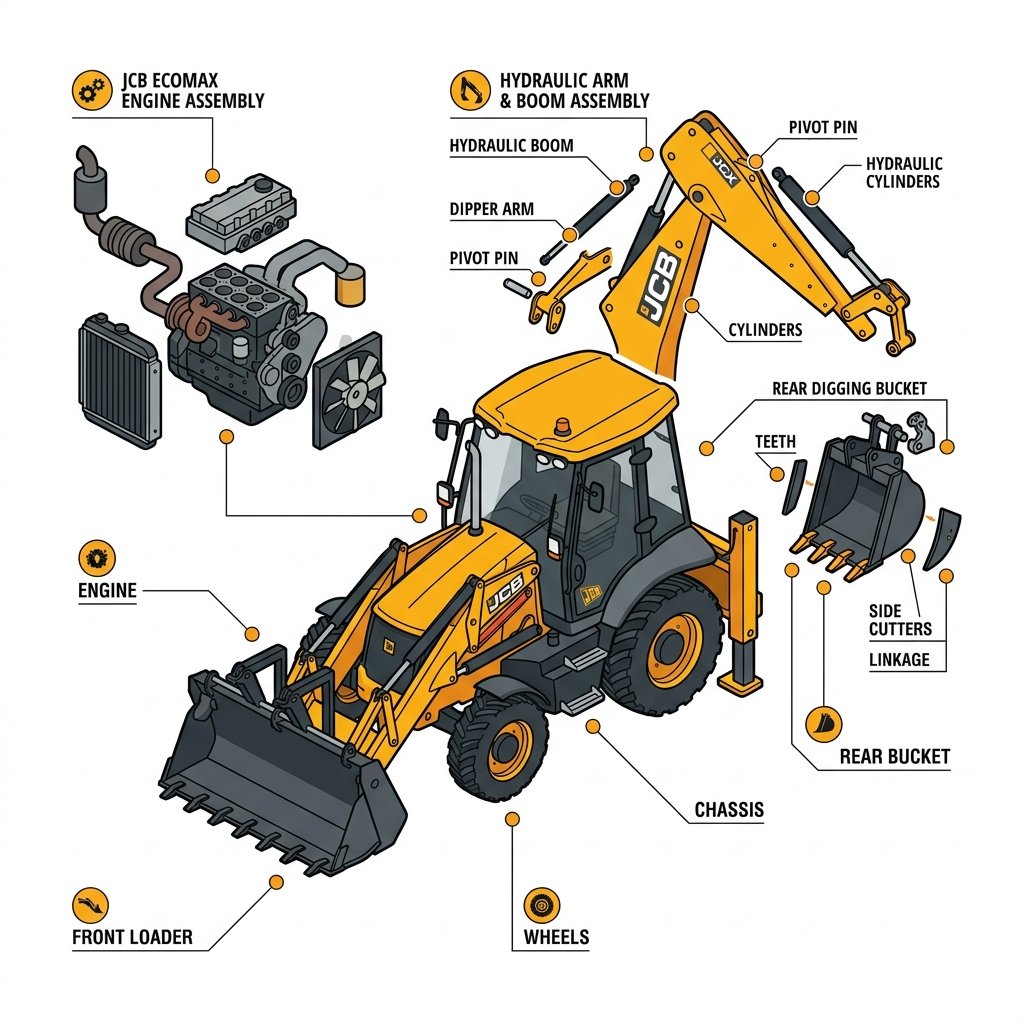
04 — MACHINERY & AGRI SPARE PARTS
Replacement Spare Parts (10,000+ Stock)
Engine overhaul kits, hydraulic pumps, seal kits, transmission shuttles, crown wheel pinions, track rollers, and GET bucket teeth suitable for JCB, CAT, Komatsu, Mahindra, MF, and John Deere. Packed in ISPM 15 heat-treated wooden crates with VCI anti-corrosion barrier protection.
ISPM 15 Wooden Crates
VCI Anti-Rust Barrier
AOG Air Cargo (AMD/BOM)

05 — ENGINE OIL & INDUSTRIAL LUBRICANTS
Engine Oil, Hydraulic Fluids & Lubricants
Heavy-duty 15W-40 CI-4 diesel engine oils, ISO VG 46/68 anti-wear hydraulic oils, Universal Tractor Transmission Oils (UTTO), gear oils, and EP-2 lithium greases. Exported in UN-rated 208L steel drums, 1000L IBC totes, or 20L heavy-duty pails with complete Material Safety Data Sheets (MSDS) & Certificates of Analysis (COA).
UN-Rated 208L Drums
1000L IBC Container Totes
Full MSDS & COA

06 — IRRIGATION & GREENHOUSES
Irrigation Systems & Greenhouse Solutions
Virgin LLDPE inline/flat drip irrigation lateral pipes, micro sprayers, automatic backwash disc/sand filtration batteries, solar DC submersible water pumps, and modular galvanized polyhouse structures. Optimized container coiling and bundle bundling.
ISO 9261 Certified Drip Line
Solar Submersible Kits
Polyhouse Turnkey Coils
HOW INTERNATIONAL ORDERS MOVE
From Requirement to Dispatch
A clear export process starts with understanding the product requirement before commercial and shipment coordination begins.
01
Share the Requirement
Provide available part numbers, machine details, product specifications, quantities and destination information.
02
Requirement Review
The requirement is reviewed to understand product, application and sourcing considerations before proceeding.
03
Commercial Proposal
Product details, quantities, applicable commercial terms and shipment requirements are organized for discussion.
04
Order Coordination
Confirmed requirements are coordinated around product availability, packing, documentation and agreed dispatch arrangements.
05
Packing & Dispatch
Goods are prepared according to the product and transport requirement before being handed over for the agreed shipment process.
MOVING THE REQUIREMENT
Shipping Planned Around the Product & Destination
Different equipment requirements call for different transport approaches. Shipment planning can be coordinated according to product size, quantity, urgency, destination and agreed commercial scope.

SEA FREIGHT
Ocean Freight
Suitable for containerized machinery, larger component requirements and consolidated international shipments.

AIR FREIGHT
Air Freight
An option for smaller, urgent or time-sensitive component requirements where practical.
GATEWAY LOGISTICS
Export Gateway Coordination
Movement toward the agreed Indian port, airport or logistics gateway can be coordinated as part of the shipment requirement.
PREPARED FOR TRANSIT
Packaging Based on the Product, Not a Standard Box
Heavy components, precision parts and machinery do not have identical handling requirements. Packing is coordinated according to product type, size, weight, surface sensitivity and intended transport mode.



BEYOND THE CARGO
Organized Information Around Every Shipment
International supply involves more than the physical product. Commercial, product and shipment information is coordinated according to the transaction, agreed scope and destination requirements.
GROUP 01
Commercial
Commercial invoice and packing information as applicable to the transaction.
GROUP 02
Product
Available part references, equipment information and supporting product details.
GROUP 03
Shipping
Shipment information and transport documentation according to the agreed movement.
GROUP 04
Destination
Relevant information coordinated around the destination and agreed commercial requirement.
COMMERCIAL FLEXIBILITY
Terms Structured Around the Shipment
Commercial arrangements can be discussed according to the product, destination, order structure and agreed scope of supply.
ORIGIN
EXW
INDIAN GATEWAY
FOB
INTERNATIONAL FREIGHT
CFR
DESTINATION
CIF
“Applicable commercial terms depend on the agreed transaction and shipment scope.”
PREPARE YOUR REQUIREMENT
Help Us Understand Your Requirement Faster
Providing clear product and destination information at the beginning can make the sourcing and commercial discussion more efficient.
01 — MACHINE
Machine / Equipment
Brand, model or available machine information.
02 — PART
Part / Product
Part number, reference, specification or clear photographs where available.
03 — QUANTITY
Quantity
Required quantity for each equipment or component requirement.
04 — DESTINATION
Destination
Country, city or preferred shipment destination where applicable.